|

Air
Personalities
Morning
Shows
News
Guys
Money
Girls
Program
Directors
General
Managers
Sales
Types
Engineers
Other
Alumni
The
Good Guys Today
Radio
Heaven
Alumni
In The News
Alumni
Speak!

A
Brief History
Newspaper
Articles
Print
Advertisements
Press
Releases
Ratings
Like You Wish!
Weekly
Playlists
Photos
- People
Photos
- Promotions
Station
Logos
Bumperstickers

Airchecks
Newscasts
Sports
Reports
Traffic
Reports
Sound
Offs!
Commercials
Promos
Sweepers
Jingles
Misc.
Audio

Beatlemania
Collectibles
Contesting
Promotions
Sales
Related
Engineering
Stuff
WPGC
Sister Stations
The
Great Strike
Market
Competition
Other
Radio Tribute Sites
Oldies
Stations Today
Legendary
Air Performers
Special
Thanks
Mailbag
Home
Server
space provided by:
Click
above to hear more vintage broadcast radio airchecks from the
Reel Radio Repository.
Your
tax-deductible contribution to
REELRADIO,
Inc.
will help keep this site online
This
site is in no way affiliated with WPGC Radio
today, or with
CBS Radio, Inc.
Click
above to visit WPGC today.
|
Dedicated in memory
of Jim
Collins

The
Saga of WBUZ-FM
& How It Ultimately Changed Radio Listening
1947
The
Federal Communications Commission granted a construction permit
for a new FM station to the Chesapeake Broadcasting Company, Inc.
in late 1947 to build and operate an FM station on 96.7 megacycles
at Bradbury Heights, Maryland, "just over the District of
Columbia line".
Furniture
dealer Arthur Baldwin
Curtis was President of Chesapeake Broadcasting, which selected
and was granted WBUZ-FM as call letters for the 1KW station. By
the end of the year, the station was authorized to use 420 watts
Effective Radiated Power.
WBUZ-FM's
transmitter and 255 foot tower were located at Bradbury Heights
with studios & offices in the WM&A bus station at 1510
Southern Avenue in SE, DC.
1948
The
station originally announced a target date for sign-on of Christmas,
1947
but delays caused by the failure of some equipment to arrive postponed
WBUZ-FM's debut airdate to January 18th, 1948. Programming consisted
of a hodge-podge of local shows including:
| Programming
Schedule |
| 7:00
AM |
Sign
On, News, Hymn |
| 7:05
AM |
"Buzzin'
with Freddie" |
| 7:30
AM |
News |
| 8:30
AM |
News |
| 9:00
AM |
Morning
Devotions |
| 9:30
AM |
News |
| 9:35
AM |
Top
Tune, R. Morgan |
| 10:00
AM |
Women's
Commentator - Muriel
Evans |
| 10:30
AM |
News |
| 10:35
AM |
March
Along |
| 10:45
AM |
This
Day |
| 11:00
AM |
Organ
Reveries |
| 11:15
AM |
South
Of The Border |
| 11:30
AM |
News |
| 11:35
AM |
Rambling
In Rhythm |
| 12:00
PM |
Family
Hour |
| 12:30
PM |
News |
| 1:00
PM |
Music
For Today |
| 1:30
PM |
News |
| 1:35
PM |
Star
Reporter |
| 1:45
PM |
Little
Show |
| 2:00
PM |
Pop
Concert |
| 2:30
PM |
News |
| 2:35
PM |
Prince
Georges Journal |
| 3:30
PM |
News |
| 3:35
PM |
Barn
Dance Matinee |
| 4:00
PM |
Platter
Parade; Charlie Edwards |
| 4:30
PM |
News |
| 5:30
PM |
News |
| 6:00
PM |
Sports
Buzzer |
| 6:15
PM |
Star
Dance Parade |
| 6:30
PM |
News |
| 6:35
PM |
Moments
Of Melody |
| 6:45
PM |
Between
The Lines |
| 7:00
PM |
Serenade |
| 7:30
PM |
News |
| 7:35
PM |
Starlight |
| 7:45
PM |
Lean
Back 'N Listen |
| 8:00
PM |
Casa
Loma Time |
| 8:15
PM |
Les
Brown |
| 8:30
PM |
News |
| 8:35
PM |
Three-Quarter
Time |
| 9:00
PM |
Concert
Hall |
| 9:30
PM |
News |
| 9:35
PM |
Southern
Serenaders |
| 10:05
PM |
Club
"Buzz" |
| 10:30
PM |
News |
| 11:00
PM |
Slumber
Hour |
| 11:30
PM |
News |
| 12:00
AM |
News
and Sign Off |
| Other
Shows: |
| 1:00
PM |
"Fur,
Feather & Fin",
a pet show with Margaret
Hines |
| 1:35
PM |
"Hollywood
News" with Roberta
Rule (a secretary at the station) |
| Sun.
2:45 PM |
"Little
Red Schoolhouse", a child talent show |
In
an article
from the Washington Post dated 02/01/48 (barely two weeks
after the station signed on), much was made of the station being
self-supporting in terms of advertising revenue and not dependent
on an AM sister station to keep it afloat financially.
1949
During
1949, Chesapeake Broadcasting's Treasurer (& WBUZ-FM's General
Manager), Leslie L. Altman
was named President of Chesapeake Broadcasting. WBUZ-FM then began
the practice of 'transit-casting', playing music for the fleet
of busses of the Washington, Marlboro & Annapolis Bus Line
(which Leslie L. Altman
was Founder & President of).
1950
In
1950 Leslie L. Altman
acquired 22.24% of the Chesapeake Broadcasting Co. in a reorganization
move that may have been precipitated by financial concerns. The
reason for the abandonment of local programming on WBUZ-FM is
not clear but it's possible that once the novelty of the new station
wore off, advertiser interest in it may have waned to the extent
that the station could not support it's operating expenses.
1951
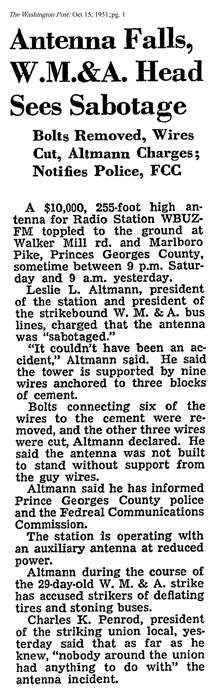
The
WBUZ-FM transmitter tower in Bradbury Heights was felled by vandals
on October 13th, 1951. At the time, the WM&A Bus Line was
the target of a labor dispute with its drivers. The station later
returned to the air with 50 watts using a temporary antenna until
a new tower could be erected and full power restored.
1952
In
1952, the 'transit-casting' concept, in vogue over a number of
independently operated FM stations across the United States, was
attacked by the Transit Riders Association, winning at the U.S.
Supreme Court level the right not to hear FM commercial programming
on municipal transportation. The practice was discontinued in
1953. Programming during this period is not known.
1953
WBUZ-FM
applied for an increase in power to 6.3KW in May 1953, the same
month the City of License was changed from Bradbury Heights to
a new subdivision, Oakland, MD. On June 8, 1953 the FCC authorized
the station to raise power again to 18,000 watts.
1954
The
power increase and potential interference elsewhere on the dial
may have been why WBUZ-FM changed frequencies from 96.7 to 95.5
in 1954 (power was also brought down to 16.5KW). That year, WBUZ-FM's
President Leslie L. Altman
named Leslie Smith as the
new General Manager.
1955
Financial
difficulties cause WBUZ-FM to go silent. Several applications
with the FCC to extend the temporary authorization to remain silent
yet retain ownership of the license are approved by the Commission
during this time.
1956
A
former WPGC DJ approached the Chesapeake Broadcasting Company
with a proposal to adopt a similar format of Pop, Country and
Standards like WPGC's on WBUZ-FM. Coinciding with the relaunch
of the station, on
March 30th, 1956, WBUZ-FM changed its call letters to WRNC-FM.
(Today the WBUZ
call letters are used by an Active Rock station in Nashville).
The
format was short lived and the FM returned to darkness on the
dial.
When
WPGC had
been granted FCC approval on April 14, 1955 to increase power
to 10,000 watts it was discovered the ground conductivity beneath
the original transmitter site in Morningside was poor. Additionally,
because of potential interference problems with a station on 1580
in Canada as well as the sign on of WCMC in Towson, MD on 1570,
this necessitated additional space for a three tower, directional
array. WPGC began a search for property which led to the WBUZ-FM
site at 6369
Walker Mill Road. WPGC began leasing property from WBUZ-FM
(now WRNC-FM) to erect the three new AM towers in 1956.
With
the demise of WRNC-FM's format, WPGC struck another deal to lease
the now vacant studio and office space above the WM&A bus
repair facility at 4421
Southern Avenue in Coral Hills, MD, across the street from
the DC line.
Later
that year, in an effort to add nighttime programming to WPGC-AM's
daytime only operation, WRNC-FM was purchased from the Chesapeake
Broadcasting Company by WPGC-AM, Inc. (which had been on the air
for barely two years). $5.00 was paid for the station license
and $10,000 for its equipment and tower. FCC approval took place
on November 20th, 1956.
At
this time, WPGC-AM owner Maxwell
Evans Richmond became President of WRNC-FM and named WPGC-AM's
General Manager,
Gene Winters as GM of WRNC-FM as well.
1957
A
long drawn out process of upgrades to the FM such as the dismantling
of the WRNC-FM tower and relocation of the FM antenna to the side
of one of the three new AM towers as well as the construction
of new FM studios at the transmitter site began in preparation
to simulcast WPGC but was continually delayed by factors such
as a community group's objection to construction of additional
radio towers in their neighborhood, an extended period of inclimate
weather and a developer's refusal to sell adjacent property to
WPGC / WRNC-FM.
1958
WRNC-FM
changed call letters to WPGC-FM in mid-March 1958. (Today the
WRNC call letters are assigned to an AM Country station not presently
on the air in suburban Atlanta). Power on the FM was reduced to
15.7KW.
1959
Robert
Howard joined the station early in the year as its new General
Manager. A huge fan of Big Band music, when the FM returned
to the air from new studios at the transmitter
site at 6369 Walker Mill Road in Oakland, MD in February 1959
he changed the format in the evening after the AM had signed off
to Big Band
music. On July 2nd, 1959, the FCC authorized the station to mount
the FM antenna on the north (280 foot) tower of the AM's array.
By
this time, the Washington, Marlboro & Annapolis Bus Line was
sold to an employee group and Founder, Leslie
L. Altman retired to Florida where he resided until his death
in 1966.
1960
The
FM dropped its Big
Band format in 1960 and resumed simulcasting 100% with the
AM during daytime hours which has since gone 100% Rock & Roll
as 'The New Sound of WPGC' under new Program
Director Dean Griffith
(#1 - Dean Anthony) from WGH, Norfolk (who took his last name from
the Washington Senators' Griffith Park).
Epilogue
During
the '60's as Baby-Boomers grew up with WPGC, the station continually
conditioned its listeners to 'tune
over now' to the FM band when the AM would sign-off at dusk.
By the '70's those teenagers were now young adults who had long
been accustomed to listening to the FM side of the station at
night. As FM grew during the decade they migrated over willingly
from the AM in other dayparts too. Efforts to bolster the presence
of the FM as a hedge against AM attrition can be found in a Billboard
article from 07/08/72 in which Program
Director 'big' Wilson details
his efforts to apply AM mechanics to the FM.
The
results speak for itself. By 1974, WPGC-FM eclipsed the ratings
of WPGC-AM for the first time. Two years later in 1976, listenership
to FM radio as a whole in Washington surpassed that of AM as a
whole for the first time, making DC the first FM dominant market
in the country due in no small part to WPGC's long time effort
to convert
cume over from the AM to the FM.
Today,
WPGC-FM's Urban, Hip-Hop format can trace its roots directly back to that little 1,000 watt
FM pioneer, WBUZ.

Print
Materials
Print
Ads
Click
on image below to see enlargement.
10/26/47
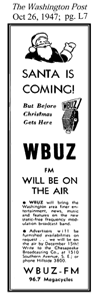
© 
|
(Thanks
to Mark Hanyok for the above).
| 12/07/47
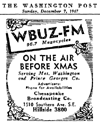
©
|
(Thanks
to Bob Bell of DCMemories.com for the above).
| 01/18/48
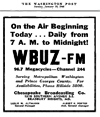
©
|
(Thanks
to Bob Bell of DCMemories.com for the above).
Articles
Click on
image below to see enlargement.
Books
Click
on image below to see enlargement.
|
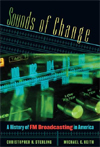
©
2008 The University
of North Carolina Press
|
Sound
Files
Misc.
Audio
 |
02/29/04 |
Ed
Walker on: Moving
to Coral Hills WBUZ Facility |
1:07 |
|
02/29/04 |
Ed
Walker on: WBUZ
broadcasting to WM&A buses |
:34 |
|

|
Small
Print Dept.:
This non-profit historical site
is not affiliated in any way with WPGC Radio today or CBS Radio,
Inc. Use of copyrighted material is consistent with the "fair
use" provisions contained in §107 of the Copyright Act
of 1976 due to the following characteristics: Use of copyrighted
material is of a nonprofit, educational nature, intended for the
sole purposes of research and comment and does not significantly
negatively affect "the potential market for or value of the
copyrighted work(s)." Use of registered trademark material
is not subject to civil action or injunction as outlined in §1114
and §1125 of the Trademark Act of 1946 (the Lanham Act) due
to the following characteristics of this work, and the registered
marks published herein: Use of reproductions of registered marks
is not for the purpose of commerce, nor is the use connected with
the sale, offering for sale, or advertising of any goods or services.
Use of reproductions is not likely to cause confusion, mistake,
or deception as to the affiliation, connection, or association of
this work with owners of published registered marks, nor as to the
origin, sponsorship, or approval of this work by owners of published
registered marks. Wherever possible, the copyright or registered
mark owner's name has been noted near the copyrighted work or registered
mark; however, all material used in this site, including, but not
limited to, newspaper articles, syndicated themes, promos, commercials,
photographs, playlists, press releases, ratings, airchecks, newscasts,
traffic reports, sports reports, 'sound-offs', sweepers, bumperstickers
and station logos, should be considered protected copyrighted material
or registered mark with all rights reserved to the owner, named
or unnamed. So there!
|
|